
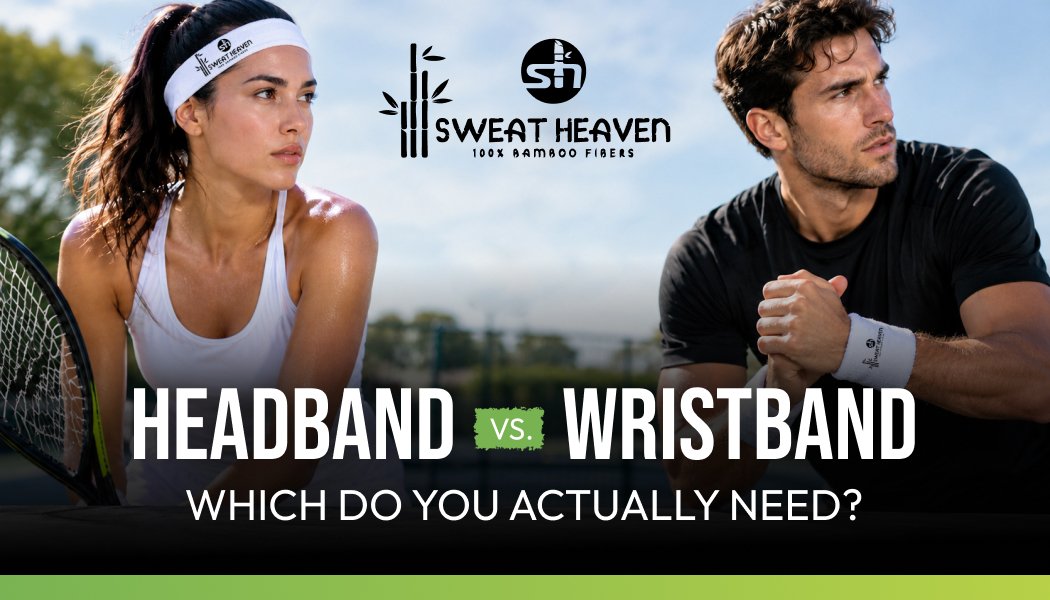
A headband and wristband may look like similar workout accessories, but they solve different problems. You notice it during a hot tennis match or workout: sweat reaches your eyes even though your wristbands are soaked, or moisture around your hands becomes distracting while your headband is working perfectly.
Choosing between a headband vs wristband comes down to where sweat is causing trouble. A headband manages moisture around your forehead and face, while a wristband helps control sweat around your wrists and forearms.
Neither is automatically better. The right one depends on how you sweat and what gets in the way of your training.
Why Your Head and Hands Sweat Differently
Sweating helps regulate body temperature. According to the Cleveland Clinic, sweat reaches the skin and evaporates, helping cool the body.
However, sweat production varies across different areas. Your forehead, hands, and arms do not necessarily produce moisture at the same rate during exercise.
That difference explains why headbands and wristbands have separate jobs. If sweat keeps reaching your eyes, something around your wrist will not solve it. If moisture around your forearms is the problem, a headband cannot manage that either.
What Does a Headband Actually Do?
A headband primarily manages forehead sweat before it reaches your eyebrows and eyes.
This is useful during tennis, running, pickleball, gym sessions, and other activities where repeatedly wiping your face becomes distracting.
A body-mapping study of male athletes done by PubMed demonstrates how different regional sweat rates can be. At the higher exercise intensity tested, researchers recorded a forehead sweat rate of 1,710 grams per square meter per hour, compared with 119 at the palms and 144 at the fingers.
Those numbers are not universal for every athlete because the research involved male athletes under specific conditions. However, they show why forehead sweat can require dedicated management during exercise.
A useful headband also needs the right combination of absorbency and fit. Too loose and it may move during a rally or run. Too tight and the band itself becomes distracting.
SweatHeaven’s bamboo headbands are made with 100% bamboo fibers for athletes looking for a bamboo option for workouts or racket sports.
What Does a Wristband Actually Do?
A wristband handles sweat around the wrist and forearm. It can absorb some of the moisture traveling toward your hand and gives you a convenient way to wipe sweat from your face during a match.
This becomes particularly useful when you are holding a racket, club, bar, or other equipment.
During longer sessions, one wristband can only absorb so much. Once it becomes heavily saturated, changing to a dry one may be more practical than expecting the same band to last through an entire match.
SweatHeaven’s bamboo wristbands are also made with 100% bamboo fibers. If you regularly play long matches, carrying a spare pair gives you something dry to switch to between sets.
Can Wristbands Help With Grip?
Grip is one reason wristbands are popular in racket sports, but a wristband does not automatically create better grip.
Research conducted by ScienceDirect, examining skin friction between hands and sports equipment shows that moisture is one of several factors affecting friction. Equipment material, texture, force, and other conditions also influence how the hand interacts with a surface.
A wristband’s role is therefore more specific. It can manage some of the moisture around your wrist and forearm before it travels farther toward your hand.
For tennis players, this becomes especially useful during longer sessions when sweat has more time to build.
Headband vs. Wristband: Which One Do You Need?
The simplest way to decide is to look at what repeatedly bothers you during exercise.
Choose a headband if:
- Sweat regularly reaches your eyes.
- You frequently wipe your forehead.
- Facial sweat distracts you during exercise.
- You want to manage moisture around your hairline.
Choose a wristband if:
- Sweat travels down your forearms.
- Your wrists become noticeably wet.
- You regularly use a racket, club, or bar.
- You want an easy way to wipe sweat during play.
If both problems happen at once, wearing both makes sense. They are not competing products; they manage moisture in different areas.
When You Might Need Both
Long matches, intense workouts, heat, and humidity can make both accessories useful.
Tennis is a good example. A headband can manage forehead sweat while wristbands absorb moisture around the wrists and forearms. During a shorter or lower-intensity session, however, one may be enough.
If grip and arm moisture are your main concerns, SweatHeaven’s guide to How sweat-absorbing wristbands support workout grip explores wristband use in more detail.
The point is not to wear more gear. Start with whichever problem actually interrupts your workout.
What to Look for in a Headband or Wristband
Once you know which accessory you need, focus on four things.
Absorbency: The band should manage enough moisture for the length and intensity of your activity.
Fit: It should stay securely in place without feeling unnecessarily tight.
Comfort: Consider how the material feels when damp, particularly if you train for long periods.
Material: Check the actual fiber composition rather than relying only on the product name. If you specifically prefer bamboo accessories, look for clear information about what the product is made from.
Your activity matters too. The best tennis wristband for a long outdoor match may not be what you need for a short gym workout.
Regular care also matters. Follow the manufacturer’s washing instructions and let your sweatbands dry completely between uses. If you train frequently, rotating between multiple bands makes it easier to have a clean, dry option ready.
Headband or Wristband? Match It to the Problem
There is no overall winner in the headband vs wristband comparison.
Choose a headband when forehead sweat and moisture around your eyes are the main issue. Choose a wristband when sweat around your wrists and forearms becomes more disruptive, particularly during activities involving sports equipment.
For long matches or hot conditions, both may be useful. For shorter sessions, one can be enough.
Instead of asking which sweatband is better, pay attention to where moisture actually interferes with your training. That tells you which accessory you need.
Frequently Asked Questions
Neither is better overall. A headband manages forehead sweat, while a wristband absorbs moisture around the wrist and forearm. Choose based on where sweat causes the most trouble.
They can help manage moisture around the wrist and forearm before it travels toward the hand. However, grip also depends on palm moisture, equipment material, texture, and other factors.
Not always. Both can be useful during long matches or hot conditions because they manage different areas. For shorter sessions, use the accessory that addresses your main sweat problem.
No. Sweatbands absorb moisture your body is already producing. Exercise intensity, temperature, humidity, clothing, and individual physiology can influence how much you sweat.
Wash them regularly, particularly after sweaty sessions. Follow the manufacturer's care instructions and allow each band to dry completely before storing or wearing it again.
Look for absorbency, comfort, and a secure fit. If you prefer bamboo, check the actual fiber composition and product information before choosing.